
You can add to our database. Just send us (
But it helps us if you send us the following details
Date of event being reported, (preferably in YYYYMMDD format)
Place ie town, village, district any other descriptor of place (if HR violation, police station and compaint number if available)
Persons (in case of HR violations include VICTIM PERPETRATOR INVOLVEMENT DATE EXACT LOCATION, if available)
Subject or give a title Give a title/headline
URL of source material
Other URL, or references
Your take or Take away points
Can we use your reference in the database
Please send the material by email to
Distinguished sociologist Andre Beteille triggered a decisive shift in the study of caste by using the lens of stratification to view the dynamic interaction between status, power and class. His ideas on social change have found wide resonance and elicited some critique as well.
Andre Beteille (1934-2026): A Life-Long Commitment to Empirical Study - The Wire



16/02/2026
Following the release of the draft agreement, several farmers’ organizations have expressed serious concerns and are preparing for a nationwide protest starting February 12. Farmers’ apprehensions are not limited to tariff concessions on soybean oil, grains, or apples. These concerns are about trust, transparency, and the future of Indian agriculture. While the government repeatedly assures that agriculture and the dairy sector will be protected, the agreement includes provisions to reduce tariffs on various agricultural and food products and remove non-tariff barriers, which has heightened farmers’ anxiety. Indian Agriculture Trapped in Global Geopolitics | Countercurrents
Previous free trade agreements with the European Union and New Zealand led to a surge in cheap imports, adversely affecting local producers. the experience of many countries in the Global South shows that FTAs often benefit multinational corporations, exporters, and advanced economies, while small farmers, local industries, and informal workers suffer.
This agreement is not only economic but also political. Midterm elections are approaching in the United States, and agriculture is a powerful political sector there. The trade war with China significantly affected American farmers and reduced export markets. Therefore, the Trump administration needs new markets. With a population of 1.4 billion, India represents a massive market for the United States. Thus, a trade agreement with India is an important part of U.S. political strategy. Reducing rural discontent and satisfying the farm lobby is politically crucial for the Trump administration.
The agreement also raises serious concerns about genetically modified (GM) crops. American agriculture is heavily dependent on GM crops, whereas India has social, environmental, and health-related concerns regarding GM crops. If free trade facilitates the entry of GM food products, it could undermine food sovereignty.
09/02/2026
https://www.youtube.com/watch?v=KR7BWMWX9YQ US
https://www.whitehouse.gov/briefings-statements/2026/02/united-states-india-joint-statement/
Full text from US website:The United States of America (United States) and India are pleased to announce that they have reached a framework for an Interim Agreement regarding reciprocal and mutually beneficial trade (Interim Agreement). Today’s framework reaffirms the countries’ commitment to the broader U.S.-India Bilateral Trade Agreement (BTA) negotiations, launched by President Donald J. Trump and Prime Minister Narendra Modi on February 13, 2025, which will include additional market access commitments and support more resilient supply chains. The Interim Agreement between the United States and India will represent a historic milestone in our countries’ partnership, demonstrating a common commitment to reciprocal and balanced trade based on mutual interests and concrete outcomes.
Key terms of the Interim Agreement between the United States and India will include:
India will eliminate or reduce tariffs on all U.S. industrial goods and a wide range of U.S. food and agricultural products, including dried distillers’ grains (DDGs), red sorghum for animal feed, tree nuts, fresh and processed fruit, soybean oil, wine and spirits, and additional products.
The United States will apply a reciprocal tariff rate of 18 percent under Executive Order 14257 of April 2, 2025 (Regulating Imports With a Reciprocal Tariff to Rectify Trade Practices That Contribute to Large and Persistent Annual United States Goods Trade Deficits), as amended, on originating goods of India, including textile and apparel, leather and footwear, plastic and rubber, organic chemicals, home décor, artisanal products, and certain machinery, and, subject to the successful conclusion of the Interim Agreement, will remove the reciprocal tariff on a wide range of goods identified in the Potential Tariff Adjustments for Aligned Partners Annex to Executive Order 14346 of September 5, 2025 (Modifying the Scope of Reciprocal Tariffs and Establishing Procedures for Implementing Trade and Security Agreements), as amended, including generic pharmaceuticals, gems and diamonds, and aircraft parts.
The United States will also remove tariffs on certain aircraft and aircraft parts of India imposed to eliminate threats to national security found in Proclamation 9704 of March 8, 2018 (Adjusting Imports of Aluminum Into the United States), as amended; Proclamation 9705 of March 8, 2018 (Adjusting Imports of Steel Into the United States), as amended; and Proclamation 10962 of July 30, 2025 (Adjusting Imports of Copper Into the United States). Similarly, consistent with U.S. national security requirements, India will receive a preferential tariff rate quota for automotive parts subject to the tariff imposed to eliminate threats to national security found in Proclamation 9888 of May 17, 2019 (Adjusting Imports of Automobiles and Automobile Parts Into the United States), as amended. Contingent on the findings of the U.S. Section 232 investigation of pharmaceuticals and pharmaceutical ingredients, India will receive negotiated outcomes with respect to generic pharmaceuticals and ingredients.
The United States and India commit to provide each other preferential market access in sectors of respective interest on a sustained basis.
The United States and India will establish rules of origin that ensure that the benefits of theAgreement accrue predominately to the United States and India.
The United States and India will address non-tariff barriers that affect bilateral trade. India agrees to address long-standing barriers to the trade in U.S. medical devices; eliminate restrictive import licensing procedures that delay market access for, or impose quantitative restrictions on, U.S. Information and Communication Technology (ICT) goods; and determine, with a view towards a positive outcome, within six months of entry into force of the Agreement whether U.S.-developed or international standards, including testing requirements, are acceptable for the purposes of U.S. exports entering the Indian market in identified sectors. Recognizing the importance of working together to resolve long-standing concerns, India also agrees to address long-standing non-tariff barriers to the trade in U.S. food and agricultural products.
For the purposes of enhancing ease of compliance with applicable technical regulations, the United States and India intend to discuss their respective standards and conformity assessment procedures for mutually agreed sectors.
In the event of any changes to the agreed upon tariffs of either country, the United States and India agree that the other country may modify its commitments.
The United States and India will work towards further expanding market access opportunities through the negotiations of the BTA. The United States affirms that it intends to take into consideration, during the negotiations of the BTA, India’s request that the United States continue to work to lower tariffs on Indian goods.
The United States and India agree to strengthen economic security alignment to enhance supply chain resilience and innovation through complementary actions to address non- market policies of third parties, as well as cooperation on inbound and outbound investment reviews and export controls.
India intends to purchase $500 billion of U.S. energy products, aircraft and aircraft parts, precious metals, technology products, and coking coal over the next 5 years. India and the United States will significantly increase trade in technology products, including Graphics Processing Units (GPUs) and other goods used in data centers, and expand joint technology cooperation.
The United States and India commit to address discriminatory or burdensome practices and other barriers to digital trade and to set a clear pathway to achieve robust, ambitious, and mutually beneficial digital trade rules as part of the BTA.
The United States and India will promptly implement this framework and work towards finalizing the Interim Agreement with a view to concluding a mutually beneficial BTA consistent with the roadmap agreed in the Terms of Reference BTA consistent with the roadmap agreed in the Terms of Reference.
https://newint.org/special/arms-trade ‘How to stop the arms trade’ is a new series from New Internationalist that explores these questions and more through a combination of in-depth articles, newsletters, discussion events and podcast episodes.
The arms trade is global, which is why global movements need to challenge it. ‘We exist in the heart of empire [in Britain],’ said Jeanine. ‘We’re strategically located within the imperial core to jam the gears of empire so we have a really important role to play in disrupting capital or disrupting the flow of capital.’
protest aimed at exposing insurers’ complicity in border militarization, fossil fuels and military equipment. In some cities offices were ‘crashed’ and a central London building was scaled by climbers unfurling banners calling for a boycott of targeted insurance companies.
‘Insurance really is a common denominator,’ explained Jeanine of the Palestinian Youth Movement. ‘Every business, every work place needs to be insured by someone. These insurers are insuring complicit companies and enabling them to continue destroying the climate and reinforcing the UK border regime, and also the genocide of our people in Palestine.’
How journalists can hold algorithms accountable in India – and beyond https://reutersinstitute.politics.ox.ac.uk/how-journalists-can-hold-algorithms-accountable-india-and-beyond In Haryana, a family-ID system meant to streamline benefits erroneously marked living people as “dead”, cutting them off overnight. In Telangana, a data-matching stack wrongly denied subsidised rations to thousands.
Imran Pratapgarhi का वायरल भाषण सुनिए राज्यसभा में शायरी सुनाकर सरकार को खूब घेरा https://www.youtube.com/watch?v=1Xu0fuEML5s Transcript & Translation
हम करें बात दलीलों से तो रद्द होती है।
उनके होठों की खामोशी भी सनद होती है।
When we speak with arguments, they are dismissed.
Even the silence of their lips becomes a testament.
कुछ ना कहने से भी छीन जाता है एजाजे सुखन
जुल्म सहने से भी जालिम की मदद होती है।
Even by saying nothing, the honor of speech is snatched away;
even by enduring injustice, the oppressor is aided.
Together in Dialogue: The Story of the Education Network: 1993 - 2025 https://ia800207.us.archive.org/35/items/together-in-dialogue-the-story-of-the-education-network-1993-2025/Together%20in%20Dialogue%20-%20The%20Story%20of%20the%20Education%20Network%201993-2025.pdf
Radical challenges got posed: How can school be a form of resistance? How is dissent to be expressed? How do we counter dominant modes of education, of life? How alternative are we to prevailing conceptions of power, authority, success?
The Education Network is an informal group of individuals, mostly coming from the Southern states of India, who are active in the field of education with “an alternative viewpoint”. We have been meeting together for the last thirty years to share concerns and experiences about education and its meaning for our personal lives and the world around u
Comment: I would also like to add "socialisation" to Education in this dialogue.. Today the digital interactions sum total seems to be affecting behaviour and also thinking/ideology like never before.. And soon this will be handed over to AI.. So unless we also simultanoeusly build the forms of resistance into digital flows through conscious acts of decentralisation of all our digital processes, and created our own networked knowledge circuits/neural connections, we will be only breed robots.. The roots underground will have to be cooperative economics, and exchange..
Only Donald Trump and US officials have released piecemeal information about the deal that has been reached; the Indian side has confirmed the deal but shown a reticence when it comes to revealing the details.
India-US Trade Deal: The Many Things We Still Don't Know - The Wire
Modi’s statement on X did not even mention the word “deal” – but he thanked the US president for reducing the tariff on Indian goods from 50% to 18%. He provided absolutely no additional details, nor did he mention what India had promised the US in return.
Since neither country has issued a formal press communique or detailed statement on the matter, the information the public has been able to glean about this reported deal is based solely on social media posts. Unsurprisingly, that’s left a lot of questions unanswered.
03/02/2026
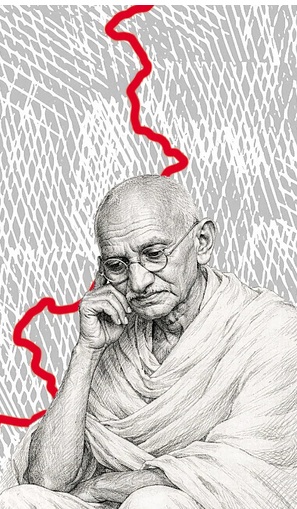 Reading Ram Madhav.. https://indianexpress.com/article/opinion/columns/ram-madhav-writes-in-his-last-days-a-dilemma-the-mahatma-couldnt-resolve-10504332/
"..But was Godse also wrong in his reasons for killing Gandhi? "
"Gandhi never wanted India to be partitioned."
"Gandhi cannot be completely absolved of his role in creating “circumstances” that led to the Partition." Godse thought so. "Indian politics, “in the absence of Gandhiji”, would surely be better,"
" He was proved wrong. India became a vibrant polity, but not in Gandhi’s absence but through his eternal presence."
QED: Eternal Presence of Gandhi made India a vibrant polity!
- Open Letter to the CJI Requesting the Withdrawal of His Remarks on Domestic Workers, Minimum Wages and Trade Unions
- Remembering Mr Bal Thackeray in his centenary
- In Varanasi, Development or Destruction?
- How The State Assails Muslim Livelihoods in the Modi Era
- Maharashtra Civic Polls 2026: Secularism and the Rise of Minority-Centric Parties
- RSS at 100 stands tall but is shadowed by a fraught past and fractious present
- What Happened to Gujarat’s Grand Projects?
- Caste in Indian cities: Why urbanisation has not brought equality
- ‘A colossal own goal’: Trump’s exit from global climate treaties will have little effect outside US
- Neoliberalism is dying: Mark Carney’s Davos speech confirmed it
- Make in India: Indian and Turkish shipyards close contract for building FSS ships for the Indian Navy
- The internet in India turns 30: EDGE
- The Silent Genocide: Looming Extinction of the World’s Last Uncontacted Peoples
- Privatisation, Monopolies and Budget Speak
- UK doctor’s plea over social media posts against BJP draws HC notice
- RBI’s BRICS Digital Currency Proposal
- The death of a lifeline called NREGA
- SHANTI or surrender? an unsettling shift in India’s nuclear liability regime and governance
- Aravalli, India’s backbone, is on the verge of breaking
- Why Lokpal’s Reports Haven’t Reached Parliament in 3 Years?