The rich get richer while global poverty deepens in “decade of division” https://peoplesdispatch.org/2024/01/16/the-rich-get-richer-while-global-poverty-deepens-in-decade-of-division/ We’re witnessing the beginnings of a decade of division, with billions of people shouldering the economic shockwaves of pandemic, inflation and war, while billionaires’ fortunes boom. This inequality is no accident; the billionaire class is ensuring corporations deliver more wealth to them at the expense of everyone else,” stated Amitabh Behar, Oxfam’s interim Executive Director
The inequality gap between the Global North and the Global South has increased for the first time in 25 years.
Rich countries of the Global North account for 69% of all global wealth and 74% of all billionaire wealth. This concentration of wealth is a legacy of colonialism and empire, the report notes, adding that “since the formal end of colonialism, “neo-colonial relationships with the Global South persist, perpetuating economic imbalances and rigging the economic rules in favor of rich nations.” This extraction of wealth has been facilitated by multinational corporations.
While the ability of governments to sustain public services is obstructed, corporations around the world have pushed for the privatization of critical services including health care and education. As the report states, this is done not only through the sale of public assets, but also through the integration of the private corporate sector into public policies and programs through outsourcing and “public-private partnerships”. Privatization in turn grants corporations greater influence over public resources.
Comment on WA: The issue is not the figures, but the politics, and the process. No wonder the "interests" need to paint "NGOs" as "desh drohi". Check out the recent attacks on Centre for Policy Research..
Earlier, India was the "vishwa guru" of the non-aligned movement, and Group of 77. Now we have "G20" !
Pradip Saha's latest book 'The Learning Trap – How Byju’s Took Indian Edtech for a Ride' is an uncommon investigative treatise into India's education system.
https://thewire.in/books/charting-the-rise-and-fall-of-byjus-and-educational-ecosystem-in-india
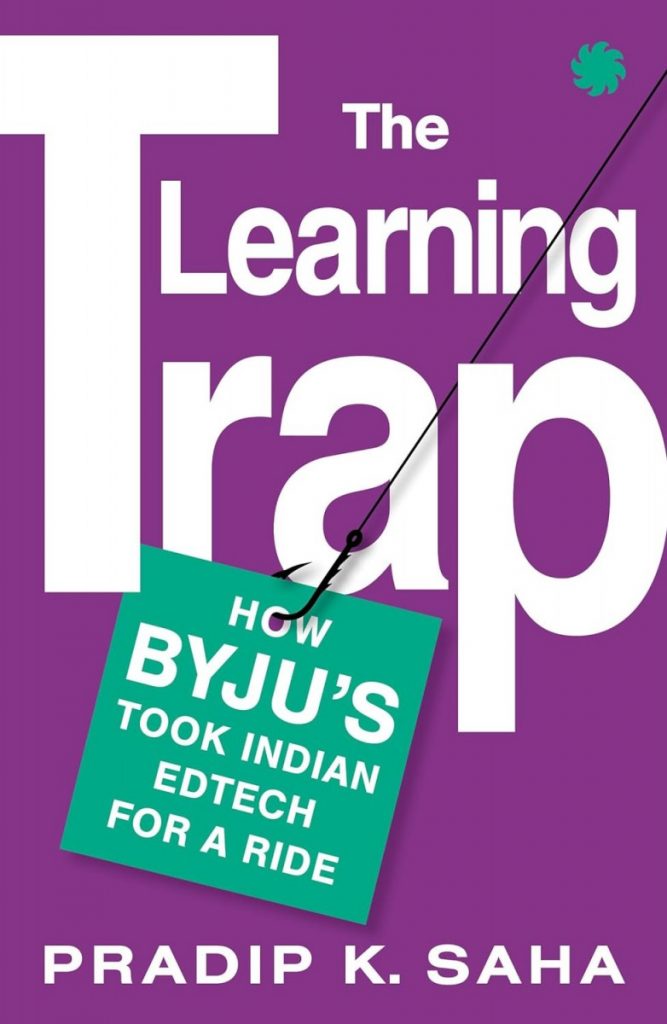
Saha charts the rise of a charismatic teacher to a status where he (and his family, who held controlling roles in the company) were clearly out of their depth, especially in financial matters. By the end, there seems little doubt that there is rampant denial and fraud, alongside the financial heartbreak of so many families and young men and women. The scepticism of these families toward education technology will likely never be allayed.
Saha quotes many heart-breaking stories of how low-income families (such as even auto rickshaw drivers) were exploited – some were denied refunds, and a lack of understanding of online subscriptions caused many families to bleed money, and end up in debt traps.
18/01/2024
The Meat of the Matter: How to Fight Casteism and Communalism https://www.theindiaforum.in/society/meat-matter-how-fight-casteism-and-communalism Anjor Bhaskar December 19, 2023
The celebration of non-vegetarianism is often a counter to the idea of supremacy and purity associated with vegetarianism. When in 2017, the union government effectively prohibited the sale of cattle for slaughter, it was met with resistance. Several states refused to implement the rules. ‘Beef festivals’ were organised to protest against the ban and the violence against Dalits and Muslims. The scholar Balamurali Natrajan notes how, these festivals were “framed popularly as an assertion of Dalit ‘cultural rights’ and identity, with beef represented as the cultural food of Dalits”. Unsurprisingly, the festivals have faced severe opposition.
Is species-ism (establishing the superiority of humans over other species) the only way to fight casteism and communalism? We do know that animals who are raised for meat or dairy are kept in highly inhumane conditions.
As Yamini Narayanan points out in her recent book Mother Cow, Mother India:Multi-species Politics of Dairying in India “the hyper-politicization of beef in cow protection discourses and practices obscures that the heavily state-subsidized dairy sector, India’s primary bovine industry, itself requires the slaughter of cows, buffaloes, sheep and other animals used for milk production. To acknowledge the role of milk in cow slaughter, however, places the Indian state in a fraught position.”
Restrictions on meat, including on beef, will impact the protein intake of the poor. Bans on sale and consumption are not coupled with measures to supply other sources of protein. This is no surprise, because prohibitions on meat does not come from a sense of animal welfare or animal protection but from a place of superiority and corresponding contempt for the marginalised.