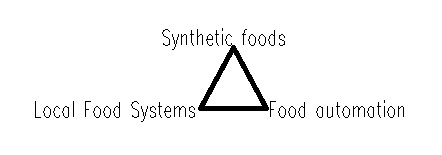
*The world is gradually moving away from locally diverse system to food automation *By Devinder Sharma https://www.bizzbuzz.news/opinion/a-food-system-triangle-that-best-serves-the-brave-new-world-of-food-1234482
 *‘food system’ refers to all the elements and activities related to producing and consuming food, and their effects, including economic, health and environmental outcomes. civil society organisations have questioned the increasing corporate influence.
there is still is no clearly defined pathway transforming food systems
the most important futuristic food systems – synthetic foods. The artificial food industry, which is growing at a fast pace, is actually using the climate neutrality targets to evolve a food system that does not employ farmers nor does it use land for food production. In other words, the synthetic food industry claims that it is keeping environment safe and encourages protection and conservation of precious biodiversity resources.
Not only in the rich and developed countries, but many startups in Bangalore and Pune are already into cellular fermentation processes to produce edible proteins. Similarly, there are ongoing projects for synthetic biology products like animal-free white egg, animal-free milk and real vegan cheese using milk from yeast. A number of dairy products on the supermarket shelves are not using milk from livestock.
transformation on food systems is increasingly moving into the hands of stock holders.
In a country like India, where roughly 50 per cent of the population is engaged in farming, the challenge is on keeping the teeming millions on the
farm with a production system that increases farm incomes, and does not aggravate the climate crisis.
We need to empower civil society actors to fine tune appropriate actions and policy interventions. showcased globally as to how it can be the climate-resilient pathway towards transforming the food systems. If people remain steadfast to naturally grown foods, using agro-ecological farming systems, which make farming economically viable and environmentally safe, the possibility is that the local diverse food system will be at the top of the food systems triangle.
the world needs a production system by the masses, and not a production system for the masses.
Inside Technology- Ownership of Knowledge: Beyond Intellectual Property Edited by Dagmar Schäfer, Annapurna Mamidipudi, Marius Buning https://direct.mit.edu/books/oa-edited-volume/5609/Ownership-of-KnowledgeBeyond-Intellectual-Property
Book pdf https://direct.mit.edu/books/book-pdf/2146062/book_9780262374644.pdf
Mikki Kendall Remembers the Indelible Work and Full Complexity of bell hooks https://lithub.com/mikki-kendall-remembers-the-indelible-work-and-full-complexity-of-bell-hooks/
When hooks wrote about power and how power relations are built into how we perceive one another; her work validated my personal belief that not looking away, being confrontational, rebelling against demands of being ladylike isn’t falling into the stereotype of being an Angry Black Woman, it is instead a way to short-circuit the power dynamics that seek to force women into perpetual subservience.
Rejecting the idea that progressive social movements could function in isolation, she tied together feminism, civil rights, and even economics into all her conversations. thought process is integral to her definition of feminism, as “a movement to end sexism, sexist exploitation, and oppression.”
hooks regularly challenged Black culture to not just reinvent itself in the face of outside oppressors, but to consider what was being built and how it would impact the future. Though she did not always agree with the focus of other Black icons, she largely centered her critiques on impact, challenging thought leaders and artists to consider their sometimes outsized impact in a society that tried to limit Black creativity to what would be palatable to white audiences. Creating for more than the white gaze or the male gaze was the goal.